
Electronic table games are found in casinos across the United States. Depending on a state’s gaming definitions, electronic table games may be classified as slot machines. In some casinos, electronic table games are lower-limit versions of live table games dealt. However, in states where live table games are not permitted, electronic table games may be the only table games allowed.
US Casino Advantage is supported through advertisements and sponsors. If you or someone you know has a gambling problem, call 1-800-GAMBLER.
Electronic table game formats
US Casino Advantage classified the electronic table games found in casinos into three categories: heads-up, stadium, and multiplayer. The sections below cover the differences between each, with picture examples of games we have seen.
Heads-up electronic table games
Heads-up machines allow players to gamble without concern about other players’ speed. It starts when a player deposits money, places the minimum required bet, and the timer counts down. The game can be sped up by pushing the deal/roll/spin button. Other nearby stations do not affect the outcome or timing of the game.
Casino Wizard machines offer multiple games
Casino Wizard machines typically have four or seven video games available. However, we have seen a few installations with only three games, and one with eight options. Games include baccarat, big wheel, blackjack, craps, pai gow poker, roulette, Swap’Em Poker, and Triple Card Poker.
While many electronic table games pay 6/5 on blackjack, we have seen Casino Wizard versions that pay 3/2 and stand on a soft 17. Maximum craps odds can be found under the Help menu. While Swap’Em Poker was initially on more installations, most casinos have replaced it with Triple Card Poker. Only once have we seen both titles available.
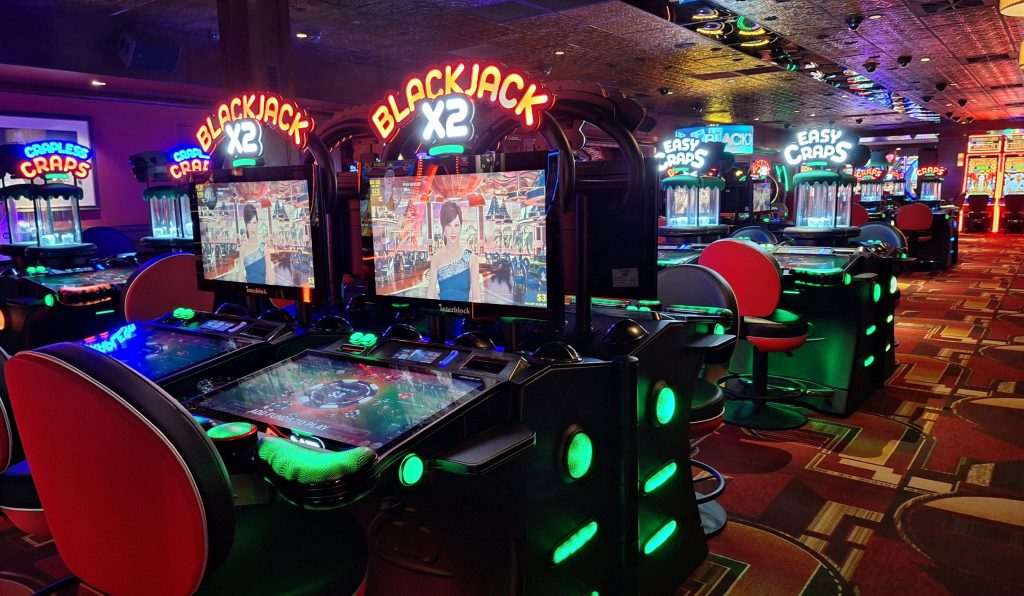
Most heads-up options only offer a single game
Craps machines have a dice bubble located at each station. Crapless craps, Easy Craps, and the rarely seen Sic Bo are other dice games with bubbles. Interblock craps, crapless craps, and Easy Craps games do not display the maximum odds. Unfortunately, it can only be determined by playing the game. Most offer double odds. Additionally, many locations are now charging the commission on Buy wagers upfront, not just on winning bets.


We have seen heads-up roulette games appear in multiple forms. Early upright Bally roulette machines may blend in with a bank of slots. Machines are available with a single-zero or double-zero wheel. Games may also short-pay straight and/or split wagers. Interblock versions have an upright wheel. A light spinning around the edge represents the roulette ball. Freefall roulette drops a ball through a series of obstacles while the wheel spins. Some carnival roulette games, like RouletteX and Power X Roulette, have also been seen in heads-up form.


While newer blackjack games have a video screen, some older versions also displayed cards. A two-player option allows two blackjack games to be played simultaneously using the same bankroll. It is available on some Interblock installations. The heads-up installations we have seen use six or eight decks. While blackjack may pay 3:2, most of the versions we have seen pay 6:5.


Other heads-up options include video baccarat and big wheel games. Interblock baccarat games appear similar to its blackjack games, while Sammy Sega Baccarat machines may blend in with a bank of slot machines. Games may be commission or non-commission versions. Heads-up big wheel games have wedges that result in random multipliers. This makes calculating the house edge impossible.


Stadium gaming
Stadium games consist of a set of machine stations and centralized action. Stadiums have multiple games. Up to four options can typically be played at the same time.
Baccarat, blackjack, craps, and roulette were the main games in most of the stadiums we saw. Other games we have found on stadiums are big wheel, Ultimate Texas Hold’em, and Three Card Poker. In stadium Three Card Poker, the dealer receives three cards. Nine cards are laid out in a tic-tac-toe pattern. Players pick three card locations to make up their hand. It and Ultimate Texas Hold’em are the least common of all stadium games.
Some more recent stadium additions have been crapless craps and Easy Craps. These games often use the same dice bubble for roll results. Another new appearance has been Reel Roulette, a carnival roulette variant.
Stadiums may also have a live dealer component. With a live dealer, all players join in the same game against the dealer. Baccarat, big wheel, craps, and roulette play and wager the same as the live versions. Each player has an individual screen to keep track of bets for each active game.


Differences from live table games
All players at a stadium blackjack game receive the same base hand at stadium gaming devices. Differences occur when some players hit or split while others stand. This could create different results for both sets of players and a different resulting dealer’s hand. Cards are dealt in the same order, but where they appear on the board depends on each player’s actions.
For example, one player stands on 12 against a dealer’s 2 while another player hits it. The player that stands will see the next card appear with the dealer’s hand. The player that hit receives this card. The dealer’s draw card is different for these players.
In a live Three Card Poker game, unique cards are dealt to all players. This is not true for the stadium version. Nine cards are dealt face down in three rows of three, resulting in nine different line combinations available. Each player chooses three numbers that coincide with these rows. Cards are then flipped over, and players bet according to the hands they randomly chose. The dealer’s hand is dealt separately.
Stadium baccarat, Big Wheel, craps, and roulette do not differ from the live games. Each version plays similarly. Here is a video demonstrating how stadium gaming works.
Multiplayer electronic table games
Small multi-screen setups with only one game variant are considered multiplayer gaming. These games play like the live table versions. And like a live table, the actions and speed of other players may affect the whole game. Installations offer three to eight betting stations.
Blackjack games use one, four, six, or eight decks. The number will be listed on the main screen or within the help menu. Payouts may be 3:2, 6:5, or even money on blackjack. On some installations, the dealer stands on all 17s. These three- to five-seat machines are often seen back-to-back or along a casino wall.


Modern electronic craps games typically have six to eight seats around a central dice bubble, while earlier versions used video dice that were “rolled” using a trackball. On most multiplayer craps machines, players take turns pushing a button to “roll the dice” within the bubble. Others may automatically roll after an allotted time. One Interblock version of craps allows players to choose two of the three dice available to use as their roll results. So, players sitting side by side could play two different craps games. We have also seen it as a crapless craps game.


Roulette has many forms as a multiplayer electronic table game. A traditional double-zero game has six to eight seats around a central wheel, or two wheels. While we have seen a few triple-zero versions, we have not come across a single-zero machine. A game called Bonus Wheel Roulette is even quad-zero roulette in disguise.


We have seen more and more installations of what we call carnival roulette. These are games that short-pay straight bet wagers in exchange for the chance of a random multiplier. Most pay 28:1 or 30:1 on non-multiplier straight bets, instead of the standard 35:1. Standalone installations include Reel Roulette and Roulette Xplosion. RouletteX and PowerX Roulette are found on machines that also include a traditional roulette game. Only one game can be played at a time on these machines.


While no longer as common, blackjack variants, like Free Bet, and poker pit games, like Ultimate Texas Hold’em, may be available on multiplayer machines.
Players club policies differ on these games
One of the perks of playing electronic table games is earning slot points through a players club on the action. However, the policy is different at each casino, even within the same company.
Most electronic table games permit the use of a players card. If the machine accepts the card, the player is likely rated at least equivalent to the live version of the game.
The electronic table game may also pay slot points, either at the standard level or a reduced one. If the game does not pay full points, it should have a disclosure explaining what it does instead. For example, if a player typically earns a slot point for every dollar wagered, an electronic table game may require $4 or more for that slot point. The disclosure may also say no points are earned.
The policy may also depend on the game. If blackjack pays 6:5 instead of 3:2, it is more likely to pay slot points. Games where players can bet both sides, like craps, roulette, and baccarat, are less likely to offer slot points due to fears of it being abused by those who bet player and banker in baccarat, red and black at roulette, or pass and don’t pass at craps at the same time.
Even if the electronic table game does not pay points, it may still be worth using a players card. The casino may base comps on the theoretical house edge of the game. This could trigger mailers with free offers like hotel, slot play, and food. It may also help you get deals from a casino host.
Last Updated on April 21, 2026 by Kristina Mehaffey