
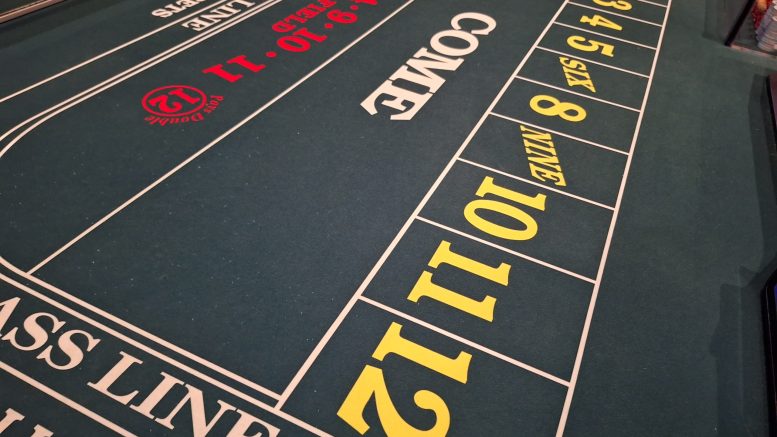
After going nearly extinct in the 2010s, crapless craps, sometimes called never ever craps or craps no more, has exploded. The game first appeared at Vegas World, which is now The Strat. That property was the only Las Vegas casino with crapless craps during our 2019 Las Vegas Table Game Survey. Today, 38 Las Vegas casinos deal live crapless craps. Even more have the electronic or hybrid version of the game.
Silverton and The Strat deal crapless craps as their only live dice games. Crapless craps has also spread to regional gaming markets over that time.
Related: Best Crapless Craps Bets – Worst Crapless Craps Bets
Crapless craps does not have Don’t Pass or Don’t Come bets. The Pass Line and Come are available. The house edge on these bets is 5.38% before taking odds. The Pass Line in a standard craps game holds 1.41%. This is the main difference between craps and crapless craps.
Crapless craps sells players on the fallacy that not losing the Pass Line on the come-out roll is a positive for the player. A 7 wins on the come-out. All other numbers become the point. This means the player does not win on an 11 until it is made twice before a 7. The same is true of the 2, 3, and 12, when these are automatic Pass Line losses in the original dice game.
A crapless craps Pass Line player wins 16.67% of the time on the come-out roll and never loses. A standard craps Pass Line bet wins 22.22% of the time and loses 11.11%. This perk gets misinterpreted as a player advantage when it is a substantially worse rule compared to the original version of the game.
2, 3, and 12 do not bring enough value to offset needing to make the 11
The 11 wins the Pass Line in craps on the come-out roll 5.56% of the time. The 2, 3, and 12 lose the craps Pass Line 11.11% of the time. So, why is crapless not better for the player?
The key is determining how often these four numbers are made when established as a point. Here is how much that matters.


Math behind the 2 and 12
The 2 and 12 become the point 1/36 of the time for each number in crapless craps. When it is the point, the player only makes it 1/7 of the time. A 7 comes the other six times. 1/7 – 6/7 is -5/7. Multiplying 1/36 by -5/7 is -1.99%, which becomes -3.98% when including both the 2 and 12.
These numbers carry a negative expectation of 2.78% each on a traditional Pass Line or Come bet, for a total of 5.56%. Each number becoming winnable as opposed to an outright loss adds 0.79% each to the player return, with rounding, both the 2 and 12 increase the return by 1.59% from the traditional game. Crapless craps seems better so far.
Math behind the 3
The 3 will be the point 1/18 of the time, or 5.56%. Once established, the player makes the point 25% of the time and loses 75% of the time, since there are two ways to roll a 3 and six ways to roll a 7. This creates a net loss of 50% when the 3 is the point, which translates to 2.78% of all come-out rolls.
In standard craps, the 3 is an immediate Pass Line loss on the come-out roll, costing the player 2/36, or 5.56%. By turning the 3 into a point instead of an automatic loss, the player avoids that full 5.56% loss and replaces it with a 2.78% loss. This improves the return by about 2.78%. So, why are these improvements bad?
Math behind the 11
The 11 also becomes a crapless craps Pass Line point 1/18 of the time, or 5.56%. Like the 3, it is made 25% of the time and lost 75% of the time. That gives the same -2.78% expectation.
However, in standard craps, the 11 is an immediate Pass Line winner on the come-out roll, occurring two out of 36 rolls, or +5.56%. When the 11 becomes a point instead, that +5.56% win is replaced with a −2.78% expectation.
Putting together the 2, 3, 11, and 12
The 2 and 12 becoming points instead of automatic Pass Line losers adds 1.59% to the game’s return. The 3 not immediately losing and having a chance to pass adds another 2.78%. However, the 11 not automatically winning, and becoming the point instead, removes 8.33% from the return.
- 2 and 12: +1.59%
- 3: +2.78%
- 11: -8.33%
- Total change: -3.96%
- Standard craps: −1.41%
- Net effect of crapless rule changes: -3.96%
- Crapless craps: −5.38%
Like most other carnival versions of games, the perceived gift is actually a negative for the player. While players avoid losing on 2, 3, and 12, the cost of turning the 11 into a point more than wipes out that benefit, creating a much higher Pass Line hold than the traditional game. This is exactly why this game has become so popular in pits and on electronic table games. The house theoretically wins more on every roll, and many players are willing to give up this additional disadvantage.
Taking maximum odds will not save you from the larger house advantage
Most live crapless craps tables games are some variation of 3-4-5 times maximum odds. A few only permit single or double odds on 2 and 12 and double on 3 and 11. This puts the element of risk when including the maximum allowed odds and the main Pass Line bet at around 1.3%. The Pass Line bet with 3-4-5 times odds at a traditional craps game holds 0.37%.
Most bubble crapless craps games are 2x odds. That holds 2.02%, while the traditional craps game with double odds has a 0.6% house advantage.
The highest maximum crapless craps odds US Casino Advantage has found is 10 times. That holds 0.58%, while a standard 10x craps game only takes 0.18% at max odds.
Always play craps over crapless craps
As much fun as the longshots are to chase on crapless craps, the house advantage is too much to overcome. Most players are giving up three or four times the hold compared to the standard game. This adds up quickly. Stick with traditional craps for the highest player return.


